

If you run a shop, restaurant, hotel, gym, clinic, office or any other business in the UK and play music for customers or staff, you may have come across PPL, PRS for Music and TheMusicLicence.
These names are often used interchangeably, but they do not mean exactly the same thing. PPL and PRS for Music represent different categories of music rights, while PPL PRS Ltd operates TheMusicLicence for businesses and organisations that use music in public.
This guide explains what each organisation does, when a UK business normally needs TheMusicLicence, what happens with Spotify, radio and television, and how separately licensed or royalty-free business music works.
Quick answer
UK businesses that play commercially released music for customers, visitors or staff will usually need permission from the relevant copyright holders. For the vast majority of mainstream commercial music, this is commonly handled through TheMusicLicence from PPL PRS. PPL represents rights connected with recorded music, while PRS for Music represents songwriters, composers and publishers. Official UK guidance also states that a business does not need TheMusicLicence simply to play royalty-free music, provided the music is genuinely licensed for that use.
What is the difference between PPL and PRS for Music?
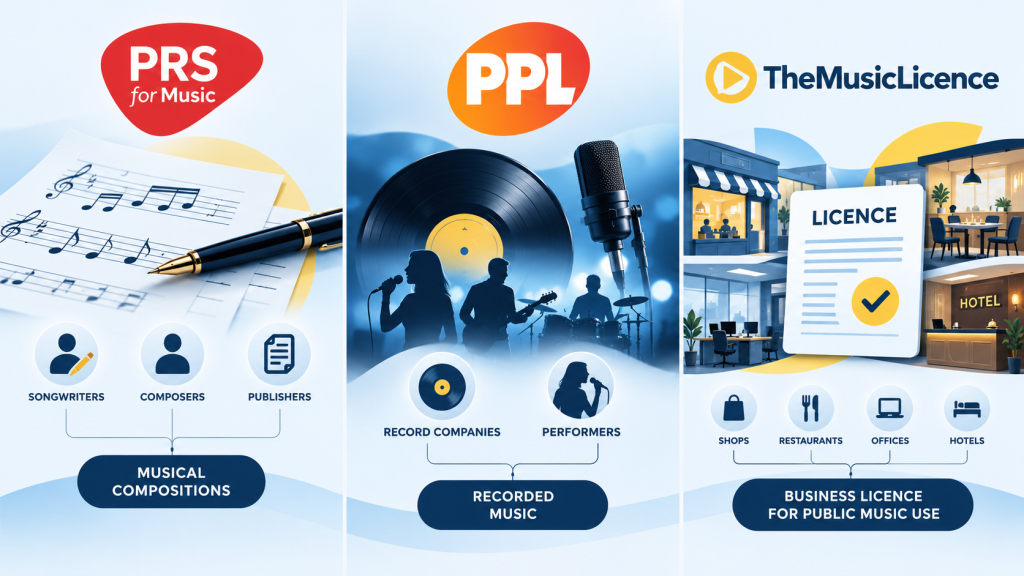
PPL and PRS for Music deal with different rights within music.
A simple way to understand the difference is to separate the song itself from the particular recording of that song.
| Organisation | Represents mainly | Rights concerned | Simple example |
|---|---|---|---|
| PRS for Music | Songwriters, composers and music publishers | Rights in musical compositions and lyrics | The song that was written |
| PPL | Record companies and performers | Rights connected with recorded music | The particular recording you hear |
| PPL PRS Ltd | Joint licensing company owned by PPL and PRS for Music | Business and public music licensing through TheMusicLicence | One licence and one invoice for most mainstream music use |
PPL PRS explains that licence fees collected through TheMusicLicence are passed to its parent companies. PPL distributes royalties in relation to recorded music on behalf of record companies and performers, while PRS for Music distributes royalties in relation to compositions and lyrics on behalf of songwriters, composers and publishers.
This distinction matters because one piece of music can involve more than one copyright interest at the same time.
What is TheMusicLicence?
TheMusicLicence is the licence offered by PPL PRS Ltd for businesses and organisations that use mainstream commercial music in public.
Before PPL and PRS for Music created their joint licensing company, businesses could need separate licences from the two organisations. TheMusicLicence was introduced to combine this process into a single point of contact, invoice and licence.
According to PPL PRS, TheMusicLicence gives businesses permission to play or perform music from the vast majority of commercially available repertoire represented by PPL and PRS for Music.
The licence can apply to music played through sources such as:
- radio;
- television;
- digital music devices;
- recorded background music;
- and certain live performances.
The cost depends on factors such as the type of business, the size of the venue and how the music is used.
Why can one song involve different music rights?
To a customer in a shop or restaurant, a song is simply a song. Legally, however, several different rights can exist inside the same piece of recorded music.
For example:
- a songwriter creates the musical composition;
- a lyricist may write the words;
- one or more performers record the song;
- a record company or producer may own or control rights in the recording;
- and publishers may administer rights in the underlying musical work.
This is why PPL and PRS for Music perform different functions.
Permission relating to the musical composition does not automatically mean permission relating to the recording, and vice versa.
Does every UK business need TheMusicLicence?
No single answer applies to every possible use of music.
Official UK Government guidance says that businesses will usually need a licence if they play recorded music in public or at their business, including background music played from a CD, radio or music channel.
The guidance specifically lists environments such as:
- shops;
- offices and factories;
- hairdressers and beauty salons;
- hotels and guesthouses;
- restaurants and cafés;
- pubs and bars;
- gyms and health facilities;
- clubs;
- and many other public or commercial premises.
For mainstream commercially released music represented by PPL and PRS for Music, TheMusicLicence is therefore the usual route for obtaining permission.
However, the answer ultimately depends on what music is actually being played and which rights are involved.
Do I need TheMusicLicence for royalty-free music?
Official UK Government guidance makes an important distinction:
you do not need TheMusicLicence simply to play royalty-free music.
This does not mean that any track labelled “royalty-free” on the internet can automatically be used in a shop, restaurant or other commercial venue.
The business still needs to make sure that:
- the provider has the necessary rights;
- the licence actually allows commercial or public playback;
- the territory includes the United Kingdom;
- the intended business use falls within the licence;
- and the business complies with the provider’s terms.
The key distinction
TheMusicLicence is designed primarily to license the repertoire represented by PPL and PRS for Music. A separately licensed royalty-free catalogue can follow a different licensing route, provided the necessary rights for commercial playback are properly controlled and authorised.
Can I play Spotify in my shop, restaurant or business?
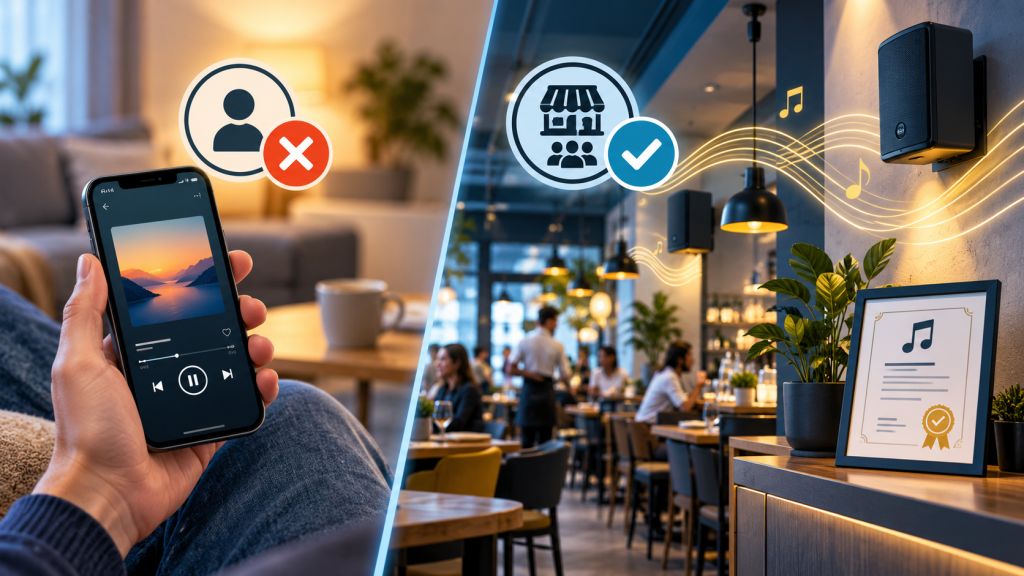
Spotify’s consumer service is not licensed for public or commercial playback in a business.
Spotify states in its own support documentation that its service is for personal, non-commercial use and cannot be broadcast or played publicly in businesses such as bars, restaurants, shops, salons, schools or dance studios.
This applies even if the account is a paid Premium account.
Paying for access to music as a consumer does not automatically give a business the right to use that service publicly.
Important: a Spotify Premium subscription changes the consumer listening experience, but it does not turn a personal Spotify account into a commercial background music licence.
If your business needs music throughout the working day, use a service specifically designed for commercial environments.
What about playing the radio or television in a business?
Radio and television should be considered separately from a dedicated business background music service.
A radio station may broadcast thousands of commercially released recordings. Television may include music inside programmes, adverts, films, sports broadcasts and other audiovisual content.
UK Government guidance specifically identifies radio and music channels as examples of recorded music use that will usually require permission when played publicly in a business.
Therefore, subscribing to a separate royalty-free background music service does not automatically cover:
- radio;
- television;
- Spotify;
- YouTube;
- Apple Music;
- personal playlists;
- or another external source.
Each music source needs to be considered on its own.
Can music be licensed directly from rights holders?
Yes.
UK Government guidance on licensing bodies explains that permission to use copyright material can sometimes be obtained directly from the rights holder, although collective licensing is commonly used where many different rights holders are involved.
Direct licensing is particularly relevant to business music services that control or license a specific catalogue separately from mainstream commercial repertoire.
Instead of giving a business access to virtually all popular commercial recordings, a provider can make available a defined catalogue for which it has obtained the relevant commercial-use rights.
This makes the scope of the service easier to identify:
- which music is included;
- where it can be played;
- what type of commercial use is permitted;
- how long the licence lasts;
- and what documentation the business receives.
How does SoundToro work for UK businesses?
SoundToro is a professional background music service created for shops, restaurants, hotels, offices, clinics, gyms, salons and other commercial environments.
The service provides access to a defined music catalogue through online streaming, together with service documentation and a usage certificate linked to the customer’s subscription.
Rather than using mainstream consumer streaming services or commercial radio, a business can use the SoundToro catalogue as its dedicated background music source.
SoundToro’s UK service is based on a separately licensed catalogue intended for commercial use. Its licence and certificate apply to the SoundToro catalogue played through the official platform.
For more detail, see our dedicated page explaining SoundToro as an alternative to PPL and PRS for business background music.
Does SoundToro replace TheMusicLicence?
The answer depends on what music your business actually uses.
If a venue plays mainstream commercial repertoire represented by PPL and PRS for Music, it will normally need the appropriate permission for that repertoire.
If instead the venue uses only a separately licensed royalty-free catalogue designed for commercial playback, UK Government guidance recognises royalty-free music as a separate case.
SoundToro’s licence applies specifically to the SoundToro catalogue used in accordance with the service terms.
It does not extend to external sources such as:
- Spotify;
- radio;
- television;
- YouTube;
- Apple Music;
- commercial CDs;
- or other third-party music services.
If these sources are used alongside SoundToro, they must be considered separately.
Best practice
If a business wants its SoundToro documentation to correspond exactly with the music being played in the premises, it should use only the SoundToro catalogue as its background music source and avoid mixing it with personal streaming accounts, commercial radio or other third-party repertoire.
SoundToro, Spotify and TheMusicLicence compared
| Music source | Designed for business use | Type of repertoire | Business documentation |
|---|---|---|---|
| Spotify consumer account | No | Mainstream commercial catalogue | No commercial public-playback licence |
| Radio / TV | Not as a dedicated business music licence | Mixed commercial content | Not specific to your background music repertoire |
| TheMusicLicence | Yes | Vast majority of commercially released music represented by PPL and PRS | Licence from PPL PRS |
| SoundToro | Yes | Separately licensed SoundToro catalogue | Service licence and usage certificate |
Practical examples for different types of businesses

A retail shop
A shop playing mainstream commercial music through radio or other commercial sources will usually need to consider TheMusicLicence.
A retailer using only a separately licensed business music catalogue can operate under the terms of that provider’s commercial licence, provided the catalogue and rights are appropriate for that use.
SoundToro allows retailers to stream curated music channels designed for shops without relying on personal streaming accounts.
A restaurant or café
Restaurants frequently use several different media sources: background music, television, radio and sometimes live entertainment.
These should not all be treated as though they were covered by one background music subscription.
If a restaurant uses SoundToro for background music but also shows television or plays mainstream music from another source, those other uses remain outside the SoundToro licence.
You can explore our background music solution for restaurants.
A hotel
Hotels may use music in reception areas, lounges, corridors, breakfast rooms, restaurants, spas and other shared spaces.
A dedicated business music system can make it easier to keep the source of the music consistent across these areas.
SoundToro provides background music for hotels with streaming access and service documentation.
A gym or fitness centre
Gyms often play music for many hours each day and may use different styles for general training, classes or relaxation areas.
Businesses should distinguish between music delivered by a licensed professional service and music played through personal consumer accounts.
A franchise or multi-site business
For a group operating several locations, music licensing becomes an operational issue as well as a legal one.
A central music policy can help the business:
- control which music source staff are allowed to use;
- maintain consistent branding across locations;
- avoid personal Spotify or YouTube accounts being connected in individual stores;
- keep documentation for each site;
- and manage music from a central provider.
SoundToro also provides a dedicated music solution for franchises and retail chains.
What music licensing documentation should a UK business keep?
Whatever music solution a business chooses, it is sensible to keep clear records showing where the music comes from and what permission applies to it.
Useful documentation can include:
- the service agreement or licence terms;
- invoices;
- subscription details;
- the name and address of the covered premises;
- the licence period;
- information identifying the music catalogue;
- and any certificate issued by the provider.
SoundToro customers can access a usage certificate associated with the SoundToro catalogue and their subscription.
This certificate documents the use of the SoundToro service. It should not be interpreted as covering any external music source that the business chooses to play.
What should I do if PPL PRS contacts my business?
If PPL PRS contacts your business about music use, the first step is to identify exactly what is being played in the premises.
If you use mainstream commercial music, radio, television or another source containing repertoire represented by PPL and PRS for Music, you should consider the applicable licensing requirements.
If you use only SoundToro, you can identify SoundToro as your music provider and provide the documentation associated with your subscription, including your invoice and usage certificate.
The important point is that your actual music use should match the documentation you provide.
If staff are also playing Spotify, YouTube, radio or other external music, those uses cannot be attributed to the SoundToro licence.
What does “royalty-free music” really mean?
The phrase royalty-free can be misunderstood.
It does not normally mean that the music has no copyright, no author or no rights attached to it.
Instead, it generally describes a licensing model in which the relevant use has been authorised under specific terms without the customer having to pay recurring royalties for every individual track or play.
For a business, the important questions are not simply whether a website uses the phrase “royalty-free”, but:
- who owns or controls the relevant rights;
- whether commercial public playback is authorised;
- which countries are covered;
- which catalogue is included;
- and whether the provider can supply suitable documentation.
Clear licensing terms are more important than the marketing label alone.
Frequently asked questions about PPL, PRS and music licensing for UK businesses
Are PPL and PRS the same organisation?
No. PPL and PRS for Music represent different music rights and different groups of rights holders. They jointly own PPL PRS Ltd, which provides TheMusicLicence to businesses and organisations.
What does PRS for Music cover?
PRS for Music represents songwriters, composers and music publishers and licenses rights relating to musical compositions and lyrics within the repertoire it represents.
What does PPL cover?
PPL licenses recorded music rights on behalf of record companies and performers within the repertoire it represents.
What is TheMusicLicence?
TheMusicLicence is the business music licence offered by PPL PRS. It gives businesses permission to play the vast majority of mainstream commercially released music represented by PPL and PRS for Music.
Is PPL PRS a legal requirement for every business?
Not every music use is identical. UK Government guidance says businesses will usually need a licence when they play live or recorded copyright music in public. The requirement depends on the music being used and the rights involved.
Do I need TheMusicLicence for royalty-free music?
UK Government guidance states that you do not need TheMusicLicence to play royalty-free music. However, the music still needs to be properly licensed for commercial use by the provider or rights holder.
Can I play Spotify Premium in my business?
No. Spotify states that its consumer service is for personal, non-commercial use and cannot be played publicly from businesses such as shops, restaurants, bars or salons.
Does paying for Spotify and TheMusicLicence make Spotify commercial use legal?
These are separate issues. TheMusicLicence deals with copyright permissions for repertoire represented by PPL and PRS, while Spotify’s own terms govern whether its consumer service may be used in a commercial environment. Spotify states that its consumer service is for personal, non-commercial use.
Can I play the radio in my shop?
Playing radio in a business can involve public performance of recorded music. UK Government guidance lists radio and music channels as examples of music use that will usually require TheMusicLicence when played publicly in a business.
Can music be licensed directly instead of through PPL PRS?
Yes. Copyright permission can in some cases be obtained directly from rights holders or through a separately licensed catalogue. The appropriate route depends on the music and the rights involved.
Is SoundToro an alternative to PPL and PRS?
SoundToro offers a separately licensed catalogue designed for commercial background music. Its licence and certificate apply to the SoundToro catalogue. If your business uses other sources such as mainstream commercial recordings, radio, television, Spotify or YouTube, those uses need to be considered separately.
Does the SoundToro certificate cover Spotify or radio?
No. The SoundToro certificate applies only to the SoundToro catalogue played through the official service.
Can I mix SoundToro with Spotify?
You can physically use different sources, but they do not share the same licence. The SoundToro documentation covers only SoundToro. Spotify and other external sources remain outside that scope.
What happens if my business has several locations?
A multi-site company should establish a clear music policy for all locations and make sure employees know which sources they are authorised to use. Centralising music through one professional provider can simplify both brand consistency and documentation.
Does TheMusicLicence cover all music in the world?
PPL PRS describes TheMusicLicence as covering the vast majority of commercially released music represented by PPL and PRS for Music. Music that falls outside their repertoire or is licensed separately may follow a different licensing route.
How much does TheMusicLicence cost?
The cost varies according to factors including the type and size of the business and how music is used. PPL PRS applies different tariffs depending on the circumstances.
Conclusion: identify the music before choosing the licence
The most useful question for a UK business is not simply:
“Do I need PPL PRS?”
A better question is:
“What music am I playing, who controls the rights, and what permission do I have to use it in my business?”
For mainstream commercial repertoire, TheMusicLicence is the usual licensing route and covers the vast majority of music represented by PPL and PRS for Music.
For separately licensed royalty-free music, a different route can apply. The key is to use a genuine commercial-use catalogue with clear licence terms and supporting documentation.
SoundToro provides professional background music for businesses through a defined catalogue, online streaming and service documentation designed for commercial environments.
Need professional background music for your business?
Explore SoundToro’s business music catalogue, test the service and see how our licence and usage certificate work.
Official sources and further information
- GOV.UK – Get a licence to play live or recorded music
- PPL PRS – What is TheMusicLicence?
- GOV.UK – Licensing bodies and collective management organisations
- Spotify – Public and commercial use
Updated: October 2026. This article is provided for general information only and does not constitute individual legal advice. Music licensing requirements can depend on the repertoire used, the rights involved, the venue, the way music is played and the specific circumstances of the business.